Shore Trips in Italy, Private Tours in Italy, Naples Port Shore Excursions, Naples Airport Transfer, Amalfi Drive, Pompeii Excursions

Florence - Things to see
It is the birthplace of the Renaissance. The home of the Medici family, Michaelangelo, Dante, Leonardo da Vinci and Galileo. But it’s also a land of treasures of art and architecture. The past merges with the present here, where a 15th century skyline rises over one of the most beautiful cities in the world. Florence is the perfect city to explore on foot, with Santa Croce basilica, Santa Maria del Fiore, known as The Duomo, (Old Bridge), whose most striking feature is the multitude of shops built upon its edges, held up by stilts. The bridge also carries Vasari's elevated corridor linking the Uffizi to the Medici residence (Palazzo Pitti). And Florence is just one of the many highlights of beautiful, historic Tuscany, where other places of interest range from medieval Siena to the famed Leaning Tower of Pisa and some of the best food and wine in the world. It’s Tuscany – and if you’re looking for romance and inspiration, there’s simply no place like it on earth. Join us as we discover more about this beautiful region...
THINGS TO SEE
The Duomo - Santa Maria del Fiore Cathedral
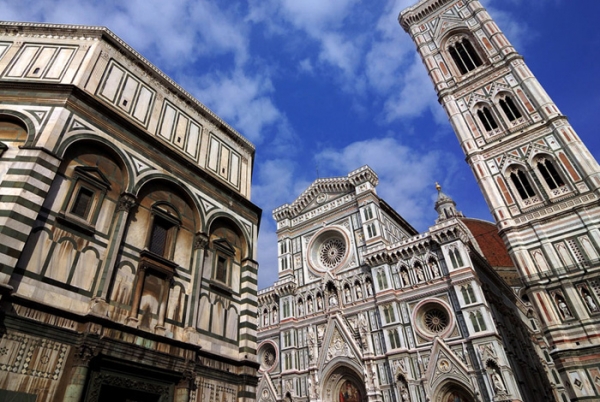
Florence's most popular site is its Duomo (cathedral). Situated in Piazza San Giovanni in front of the ancient basilica of Santa Reparata, the gothic cathedral of Santa Maria del Fiore was begun in 1296 by Arnolfo di Cambio and was consecrated and completed structurally in 1436 with the dome engineered by Filippo Brunelleschi. The exterior of basilica, made of green, pink, and white marble, has several elaborate doors and interesting statues. Inside, in the shape of a Latin cross with three naves, is of the purest and most majestic lines. Among the numerous works of art, the frescoes done for G. Acuto (by Paolo Uccello) and for Niccolo da Tolentino (by Andrea del Castagno) are especially noteworthy. Free admission.
The Baptistry
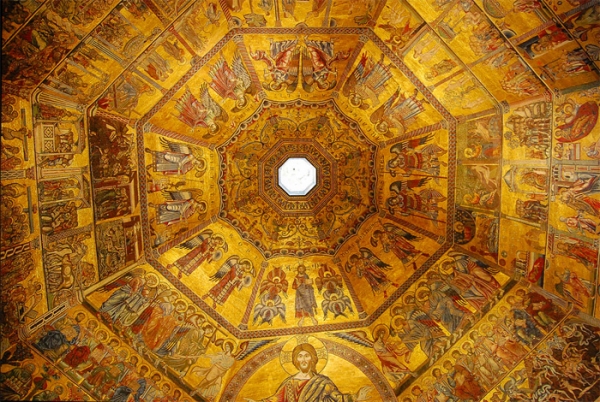
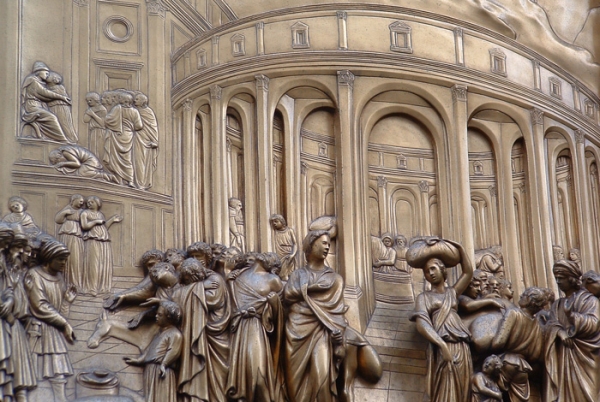
Renowned for the massive bronze doors designed by Lorenzo Ghiberti, is one of Florence's oldest buildings, located in Piazza San Giovanni beside the Duomo and Giotto's belltower, its exterior is made of green and white marble and has three sets of amazing bronze doors, the oldest by Donatello, Paolo Uccello and Masolino (1403-24). The East Door, called "of Paradise" because Michelangelo referred to it in this way, is Ghiberti's most famous work, c South Door, by Andrea Pisano (1330-36), which is divided into 28 finely-sculpted panels. The North Door, also divided into 28 panels, was completed by Lorenzo Ghiberti and illustrious collaborators such as do completed with the help of Michelozzo, Gozzoli and others (1424-52). Inside, you can see a marble pavement of the zodiac. The dome is entirely covered with precious Byzantine mosaics from the thirteenth and fourteenth century. Open 12:00-7:00 daily except holidays and 8:30-2:00 Sundays (ticket).
Pitti Palace
The Pitti Palace (15th-century), is the most Florence's largest palazzo, was once the seat of the Medici family. Its grounds cover more than three hectares at the summit of the Boboli hill. It was built for the banker Luca Pitti according to plans attributed to Brunelleschi, towards the mid-fifteenth century.
Some of the most important Florentine museums are now located in the palace and in the Boboli gardens behind it: the Palatina Gallery (on the first floor), the Silver Museum (ground floor and mezzanine), and the Gallery of Modern Art (final floor); while in the Little Palace of the "Cavaliere" on the far side of the garden is the Porcelain Museum and in the Little Palace of the Meridiana, the Costume Gallery.
Uffizi Museum and Gallery
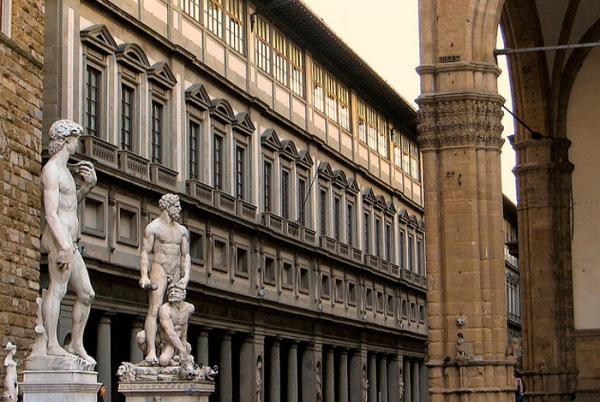
The Gallery is recognized as one of the world’s great museums, Uffizi Palace built in the mid-sixteenth century by Giorgio Vasari and finished after his death by the architects Alfonso Parigi and Bernardo Buontalenti. Located in Piazza della Signoria it extends to the Arno river and is connected to the Palazzo Vecchio by a footbridge. The Gallery holds today thousands of masterpieces of Italian and international artists of the thirteenth and eighteenth centuries, including Cimabue, Giotto, Masaccio, Beato Angelico, Leonardo, Botticelli, Michelangelo, Piero della Francesca, Raphael, Caravaggio, Rubens, Rembrandt, Durer, Goya and many others.
The Vasari Wing, leading from the Ufizzi to the Pitti Palace, holds a famous collection of self-portraits which is the only one of its kind in the world.
National Museum of the Bargello
The National Museum is housed in one of the oldest public palaces of Florence. Its construction dates to 1255. It houses a superb collection of sculptures from the Florentine Renaissance, with works by Michelangelo, Donatello, Giambologna and Cellini, as well as a collection of Mannerist bronzes.
Academia Gallery
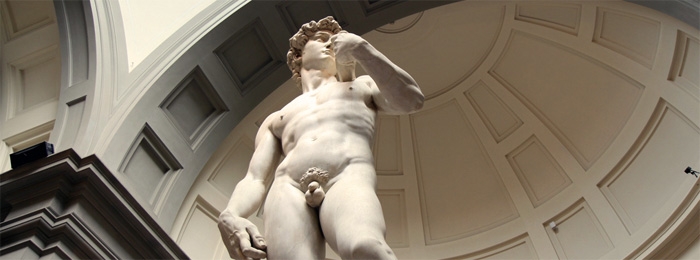
Florence's Galleria dell'Accademia holds important paintings and sculptures from the 13th-16th centuries. Michelangelo's David, probably the most famous sculpture in the world, is in the Galleria dell' Academia as well as other sculptures by Michelangelo. You'll also find an interesting collection of musical instruments, begun by the Medici family. Open Tuesday-Sunday, 8:15-6:50, sometimes later on Tuesdays in the summer.
Piazza della Signoria and Palazzo Vecchio
Florence's most famous square is Piazza della Signoria, the heart of the historic center and a free open-air sculpture exhibit. The Loggia della Signoria holds some important statues including a copy of Michelangelo's David. The piazza has been Florence's political center since the middle ages and Florence's town hall, the medieval Palazzo Vecchio, sits on the piazza, was built between the thirteenth and fourteenth centuries by Arnolfo di Cambio, the Palazzo Vecchio contains elaborately decorated public rooms and private apartments. Around the piazza are cafes and restaurants.
Church of Santa Croce
This superb 14th-century church is a fine example of Florentine and Gothic design; are buried here several important Florentines including Machiavelli, Galileo, Michelangelo and Dante. The vast interior contains some exceptional stained glass windows and frescoes. One of Brunelleschi's most important works, the Cappella dei Pazzi, is in Santa Croce. Open Monday-Saturday, 9:30-5:30 and Sunday, 1-5:30.
Ponte Vecchio
The Ponte Vecchio (old bridge) Florence’s most famous bridge, built in 1345, was Florence's first bridge across the Arno River and is the only surviving bridge from Florence's medieval days (others were destroyed in World War II). The Ponte Vecchio is still lined with shops selling gold and silver jewelry. From the bridge, you'll have a great view along the Arno River and beyond.
Related Tours
Florence City Private Day Tour: the cradle of Art
Code: PSE1-T
Departure From: Livorno Port
Duration: 9-10 hours
Private Tour: Florence City and Tuscany Countryside
Code: EXC2-T
Departure From: Florence
Duration: 9-10 hours
Private Day-Tour: Pisa and Florence City
Code: EXC3-T
Departure From: Livorno Port, Florence
Duration: 8-9 hours
Private Tour: Siena, San Gimignano and Florence
Code: EXC1-T
Departure From: Livorno Port
Duration: 9-10 hours

Italy Tours Port Promotion for 2015
Book three luxury tours from Naples area and Amalfi Coast you can choose between Naples port, Sorrento port, Amalfi Port and Salerno Port - from Rome area Civitavecchia port - from Tuscany area Livorno port
Offer available until December 31, 2014.

Pisa International Airport to Florence Private Transfer
Code: TRF2-T
Departure From: Pisa International Airport
Localities
Pompeii - Things to see
Being an important commercial centre in Campania felix, played a strategic ... Continue
Herculaneum - Things to see
At Herculaneum, unlike Pompeii, where the eruption destroyed roofs and atti... Continue
Mount Vesuvius Area - Things to see
Whoever says Vesuvius, says Campania. Neapolitans call the most famous moun... Continue
Naples - Things to see
In the shadow the Vesuvius tourism’s roots run deep: on the imprints ... Continue
The Appian Way, Rome - Things to see
A walk along the original slab stones of the ancient Appian Way is an ideal... Continue
The Catacombs, Rome - Things to see
A visit to the Catacombs on the Appian Way allows us to trace the origins o... Continue
Cerveteri - Things to see
Cerveteri or Kaisra to the Etruscans dates back to the 11th century as prov... Continue
Tarquinia - Things to see
These necropolises extend for 750 metres and contain about two hundred buri... Continue
Castel Gandolfo - Things to see
Latin: Castrum Gandulphi, colloquially Castello in the Castelli Romani dial... Continue
Pisa - Things to see
A quiet city, Pisa is a renowned cultural destination of architectural inte... Continue
Audrey & Graham Stephens - 12/06/2005
Dear Josephine,
I just wanted to say a huge thank you for the service we received from ItalyLimousine. This was the ...
Continue »

rome.italylimousine.com - naples.italylimousine.com - pompeii.italylimousine.com - sorrento.italylimousine.com - positano.italylimousine.com - amalficoast.italylimousine.com
Phone: +39 081 808 04 57 - Fax: +39 081 808 04 57 [24hrs online]
Office cells +39 338 968 1866 [24hrs line] +39 392 9900 198 Service Coordinators - E-mail: reservations@italylimousine.com
